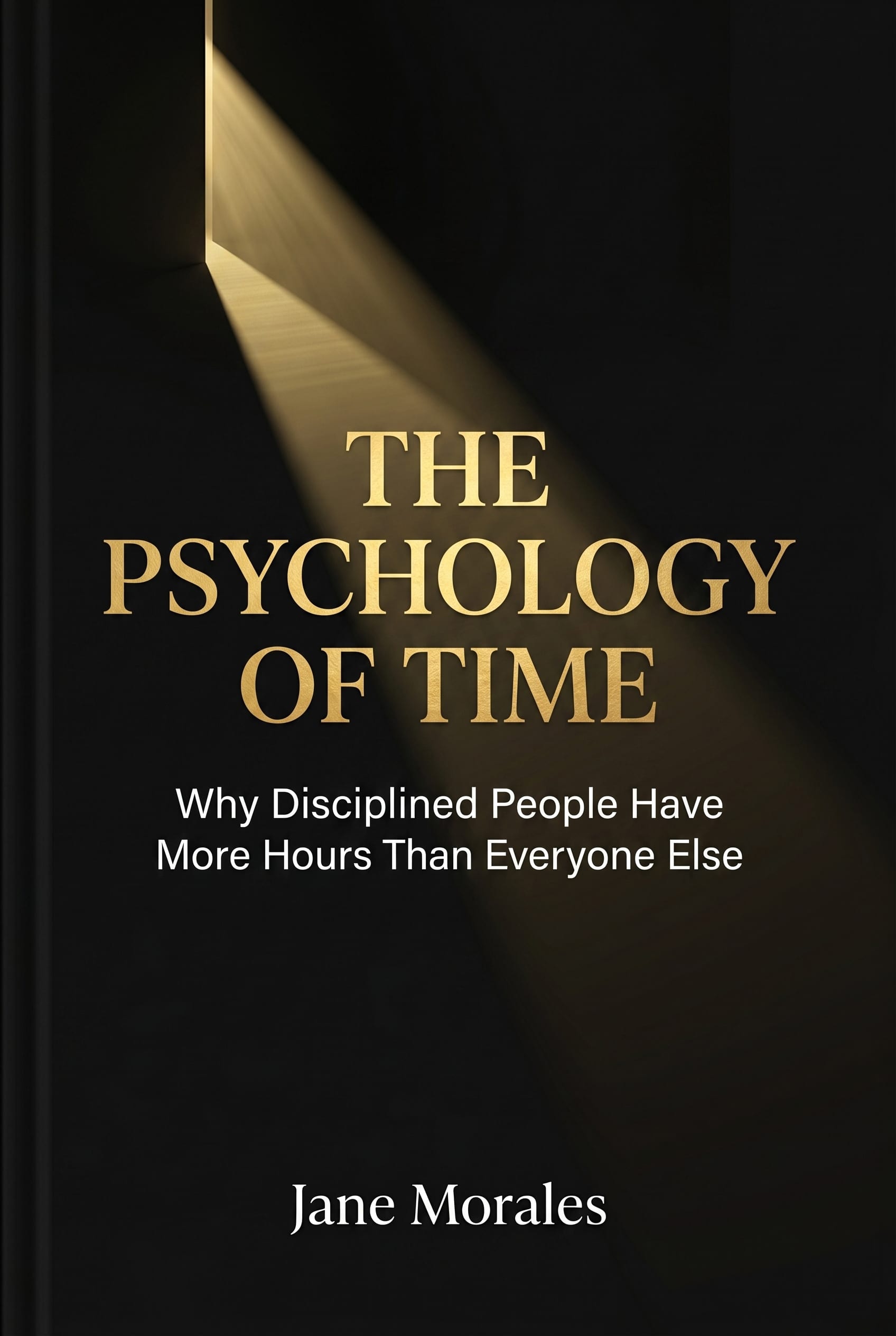
The Psychology of Time
Why Disciplined People Have More Hours Than Everyone Else
Successful people don’t get more hours in a day. They have simply solved a different problem, by mastering four inner forces: Focus, Discipline, Purpose, and Emotional Control.
Start with the introduction: You Don’t Have a Time Problem.
Where the day actually goes
Feeling busy is not the same as making progress.
What if the reason you feel overwhelmed, distracted, and constantly behind has nothing to do with time? Most people reach for calendars, planners, and productivity hacks, and the day still slips away.
That is the trap. Jane Morales argues that the gap between knowing and doing is almost always emotional, not tactical, and that willpower alone won’t fix distraction when products are engineered to override it.
The T.I.M.E. framework names what steals the hours
- Toxic Distractions
- Urgency Addiction
- Indecision
- Misaligned Priorities
- Emotional Avoidance
The answer the book gives is environment design, not more willpower.
The promise
You don’t have a time problem. You have a psychology problem.
Most people believe they have a time problem. The truth, as this book frames it, is an attention problem, a purpose problem, a discipline problem, or an emotional control problem, and the book sets out to show you how to solve all four.
Discipline isn't a personality trait. It's a design problem. And design problems have solutions.
Introduction: You Don’t Have a Time Problem
What waits inside
Four forces, and the working tools that put them to use.
Drawing from psychology, neuroscience, behavioral science, and real-world experience, the book trades productivity hacks for exercises you can run on an ordinary workday.
Attention is the currency. Time is just the container it lives in.
Chapter 2: Attention Is the Real Currency
The attention audit
Log every attention shift for one full workday. The leaks stop being a feeling and become a record you can read.
Deep work vs. shallow work
One question sorts the list: can this task be done while distracted? If it can, it is not where your best hour belongs.
Stated vs. revealed priorities
Track the real time you spend, then close the gap between what you say matters and what your hours actually protect.
The daily filter question
“Does this serve what matters most to me right now?” Purpose, used as a filter for your time and energy.
The four-step emotional avoidance process
Name the task, name the feeling, shrink it, schedule it. Shrink the avoided task to its smallest starting point and put it on the calendar within 48 hours.
The ten-step intentional time blueprint
The closing design for a life built on intentional action rather than constant reaction.
Who this book is for
For capable people who are busy and still under-fulfilled.
- You are ambitious and busy, yet the full days leave you under-fulfilled.
- You already know the standard productivity advice, and you have tried the planners.
- You suspect the real problem runs deeper than your schedule.
- You catch yourself in endless preparation instead of starting.
- You want importance, not urgency, to decide what gets your hours.
Urgency builds busy lives. Importance builds meaningful ones.
Chapter 5: Purpose Is the Engine
The goal was never to find more time.
It is to become the person who knows exactly what to do with the time you already have.
Buy on AmazonCarry one question out the door: does this serve what matters most to me right now?